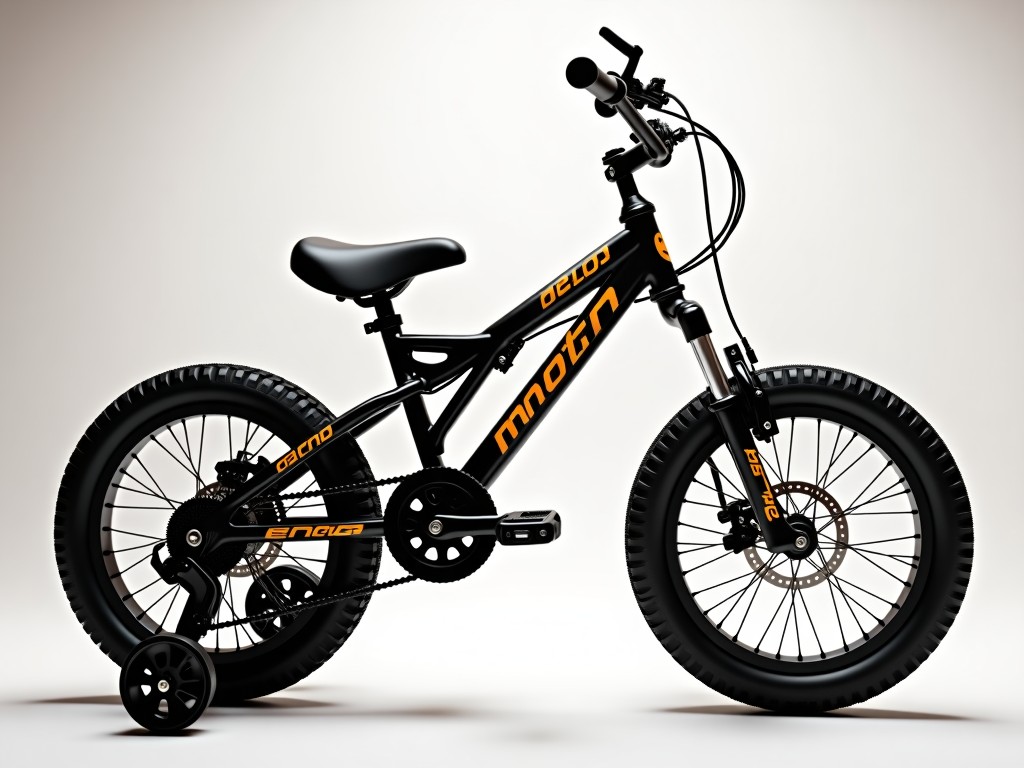
Custom Review Kids Mountain Bike Manufacturer
Custom Review Kids Mountain Bike Manufacturer
We engineer mountain‑bike frames specifically for children aged 5‑12, focusing on geometry that matches developing biomechanics rather than scaling down adult designs. Each model starts from a baseline 20‑inch or 24‑inch wheel platform, with adjustable reach and stack to accommodate inseam ranges from 45 cm to 60 cm.
Design & Engineering Principles
Frame angles are tuned to a 68° head‑tube angle and 73° seat‑tube angle, providing stable steering on loose terrain while keeping the rider’s center of gravity low. Chainstay length is set between 380 mm and 410 mm to balance maneuverability and pedal clearance for small cranks.
The downtube incorporates internal cable routing to reduce snag risk on branches, and the bottom‑bracket shell width is 68 mm (BSA) to accommodate standard cranksets. All tube junctions are hydroformed where possible, achieving a 15 % weight reduction over conventional butted tubing without sacrificing fatigue life.
Material Options & Mechanical Properties
- 6061‑T6 aluminum alloy – density 2.70 g/cm³, ultimate tensile strength ≥ 310 MPa, elongation ≥ 12 %.
- 7005 aluminum alloy – density 2.78 g/cm³, ultimate tensile strength ≥ 350 MPa, suited for higher‑stress fork crowns.
- Hi‑tensile steel (4130 chromoly) – density 7.85 g/cm³, yield strength ≥ 460 MPa, provides natural damping for rough trails.
- Carbon‑fiber reinforced polymer (CFRP) layup – specific modulus ~ 70 GPa/g·cm⁻³, targeted for sub‑1.2 kg frame sets in premium models.
Material selection is based on target weight, intended use (recreational vs. competitive), and budget constraints; each option is accompanied by a finite‑element analysis report showing stress distribution under a 150 kg rider load (including dynamic factors).
Customization Choices
Buyers can specify the following parameters, each adjustable in 5 mm increments unless noted:
- Frame size (effective top tube length) – 340 mm to 420 mm.
- Fork travel – 40 mm rigid, 60 mm suspension, or 80 mm air‑sprung.
- Brake system – V‑brake (rim), mechanical disc (160 mm rotor), or hydraulic disc (160 mm rotor).
- Drivetrain – single‑speed freewheel, 7‑speed Shimano Tourney, or 9‑speed micro‑shift.
- Tire width – 1.95″ to 2.4″ with optional puncture‑resistant casing.
- Color finish – powder‑coat RAL options, matte or gloss, with custom graphics via sublimation.
Quality Control & Testing Protocol
Every frame undergoes three‑step validation: (1) dimensional inspection via CMM (±0.1 mm tolerance on critical mounts), (2) static load test to 200 % of rated rider weight for 30 seconds with no permanent deformation, (3) fatigue test per ISO 4210‑2, 100 000 cycles at 2 Hz with a 120 kg equivalent load. Forks receive additional impact testing using a 2 kg drop‑weight from 150 mm height onto the crown‑race interface.
Welds are examined by dye‑penetrant inspection; aluminum frames receive a post‑weld heat treatment (T6) to restore temper. Final assembly includes torque verification of all fasteners to manufacturer‑specified values (e.g., stem bolts 5–6 Nm, brake caliper mounting bolts 6–8 Nm).
Applications & Value Proposition
The bikes are suited for trail networks with gradients up to 12 %, packed‑earth surfaces, and light technical features such as roots and rocks. Geometry promotes confident handling for novice riders while allowing progression to more aggressive riding as skills develop. For OEMs, the modular design reduces inventory complexity: a single frame size can serve multiple wheel‑size options through interchangeable dropouts and fork crowns.
Institutional buyers (schools, municipal recreation departments) benefit from a documented maintenance interval: basic safety check every 20 hours of use, full drivetrain service every 80 hours, and frame inspection annually. This predictability lowers total‑ownership cost compared to generic children’s bikes that lack structured service guidelines.
Typical Specifications
| Parameter | Base Model (20″) | Customizable Range |
|---|---|---|
| Wheel Size | 20 inch (ISO 406) | 20 inch or 24 inch (ISO 507) | Frame Weight (6061‑T6) | 1.8 kg | 1.5 kg – 2.2 kg (depends on material & size) |
| Recommended Rider Height | 105 cm – 130 cm | 95 cm – 145 cm (adjustable via stem & seatpost) |
| Maximum Load | 60 kg | 50 kg – 80 kg (frame‑specific) |
| Brake Type (std.) | V‑brake | V‑brake, mechanical disc, hydraulic disc |
| Gear Options | Single‑speed | 1‑speed, 7‑speed, 9‑speed |
Frequently Asked Questions
- Can dimensions be customized? Yes – top‑tube length, seat‑tube angle, and chainstay length are adjustable in 5 mm increments to match rider proportions.
- What information is required before quotation? We need target rider height/inseam, intended use (trail, pavement, mixed), preferred wheel size, brake type, drivetrain level, and any branding or color specifications.
- What materials are available? 6061‑T6 aluminum, 7005 aluminum, 4130 chromoly steel, and carbon‑fiber layup; each with associated weight and strength data.
- How is quality inspected? Dimensional CMM check, static load test, ISO 4210 fatigue test, and weld dye‑penetrant inspection are standard; reports are available upon request.
- What packaging methods are available? Frames are packed in double‑wall cardboard with corner protectors; complete bikes are boxed with foam‑filled compartments to prevent movement during transit.
- How are export shipments protected? Palletized, heat‑shrink wrapped, and secured with poly‑strapping; optional ISPM‑15 compliant wooden crates for high‑value orders.
- What is the typical production lead time? 4‑6 weeks for standard configurations; 8‑10 weeks for custom paint or carbon‑fiber frames, subject to material availability.
- How are samples arranged? We can ship a pre‑production sample (frame only or complete bike) at cost; the sample fee is credited toward the first order.
For further details or to request a formal quotation, please contact our engineering team.
Request a Quote